This article contains affiliate links. If you buy through them, we may earn a commission at no extra cost to you. Learn more.
The Breakdown
IPTV delivers live TV over the internet, but not every iptv subscription service is the same. Here’s what they actually do, what they cost, and how to buy one safely.
In Brief
- What most people call an IPTV subscription service is a budget internet-TV offer — usually $10–$20 a month — not a licensed platform like YouTube TV.
- The technology is legal, but content rights are the gray area: prices that low exist because the provider may not hold full broadcast licensing.
- Reliability varies widely from provider to provider, so free trials and one-month plans are the only sensible way to start.
- A VPN, anonymous payment, and a tested player app are the three safeguards that make trialing a new IPTV service much safer.
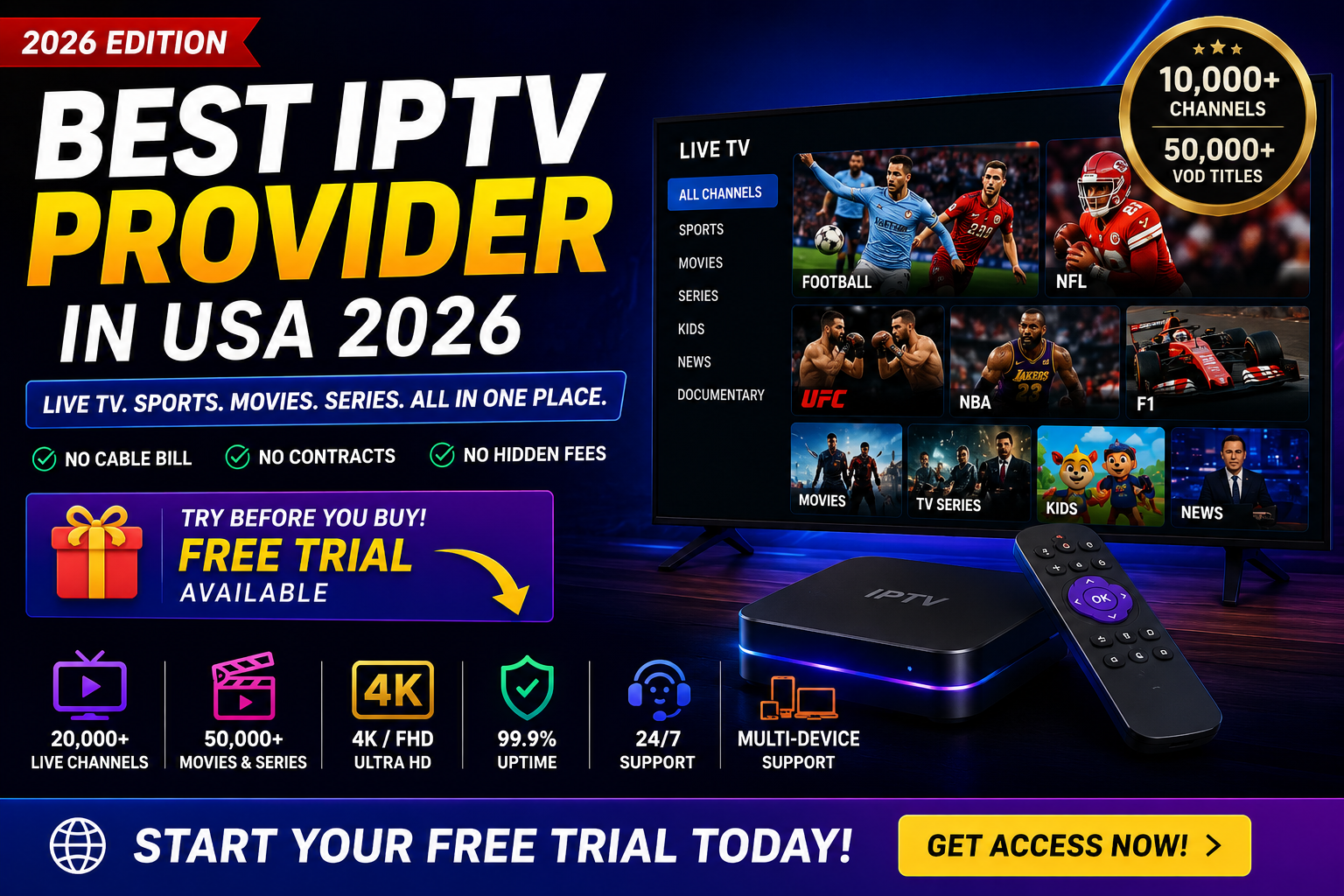
IPTV stands for Internet Protocol Television. In plain language, an iptv subscription service is a paid way to watch live TV channels over your broadband connection — through an app on your smart TV, phone, tablet, Fire TV Stick, or computer — instead of through a cable decoder or satellite dish. The setup shown in the photo above, a channel grid running on a large screen, is what that looks like in practice.
Before comparing prices, understand the split. Fully licensed services such as YouTube TV, Hulu + Live TV, FuboTV, and Sling TV are all technically IPTV. At the other end, budget IPTV services sell multi-thousand-channel packages for a tenth of the price. Most of what comes up when you search for an iptv subscription service belongs in that second, much murkier category.
Keep one sentence in your head during the whole hunt: a subscription is only a bargain if the stream still works in the month after you pay for it. No channel count or glossy landing page changes that. This guide walks through what these services are, how they work under the hood, the honest trade-offs, and a step-by-step buying routine that keeps your risk close to zero.
What is an IPTV subscription service, exactly?
IPTV describes any television service delivered over an internet protocol network instead of via broadcast, cable, or satellite. It’s a technical category, not a specific brand. Besides the big live-TV streaming platforms, most modern telecom TV offerings are IPTV too.
What most buyers mean by “iptv subscription service” is the budget tier: a website selling a login for $10 to $20 a month that unlocks a large international channel list covering sports, news, movies, and entertainment. These services are usually sold as M3U playlist files or Xtream Codes, and they rely on a separate player app to display the channels.
You’ll meet related terminology along the way: EPG, the electronic programme guide that fills in the schedule; VOD, the on-demand movie library; resellers, middlemen who buy access in bulk and resell it; and IPTV player apps such as TiviMate, IPTV Smarters, and VLC. None of these are the service itself — they’re the tools around it.
How IPTV works, step by step
IPTV sends television as data packets that travel from the provider’s servers to your device over the internet. A traditional broadcast sends one signal to everyone at once; an IPTV stream is a one-to-one connection — you fetch the channels you want, when you want them. In practice the process looks like this:
- Pay for a plan. The provider activates your account and emails your login details, usually within minutes.
- Install a player app. Most budget services don’t build their own apps, so you use a generic player — TiviMate on Android TV and Fire TV, IPTV Smarters on mobile and boxes, or VLC on a desktop.
- Enter your credentials. This can be an M3U URL, a username and password via Xtream Codes, or a short-lived activation code.
- The player pulls the channel list and EPG. Your channels appear in a familiar grid, sorted into categories like Sports, News, Kids, or Documentaries.
- Press play. The player fetches the live video over your connection. For smooth HD you generally want 10–25 Mbps; 4K channels need more, and a wired Ethernet connection beats Wi-Fi for consistency.
“A subscription is only a bargain if the stream still works in the month after you pay for it.”
Concrete benefits of an IPTV subscription service
The reason these services keep selling is that they fill real, specific gaps. Here are the scenarios where they make the most sense.
Sports without the bundle. A fan who follows one league or one national team can get targeted channels for less than the monthly cost of a premium sports add-on. PPV events and out-of-market games are among the most common reasons people subscribe to budget IPTV in the first place.
Home-country channels, anywhere. Expat households use IPTV to watch national news, soaps, and kids’ channels that no licensed streaming service carries in their new country. This is the single biggest use case for international channel packages.
Multi-device coverage. A typical subscription allows one to three simultaneous connections, so a single plan can run the living room TV, a bedroom device, and a phone at the same time — effectively replacing several TV bills.
Month-to-month flexibility. Most budget plans are sold without an annual contract. That makes it easy to leave when quality dips, which is more than you can say for a two-year satellite agreement.
A price that’s hard to argue with. The headline economics are simple: one year of a typical cable package often costs more than several years of a budget IPTV plan. That math explains the category’s popularity.
Honest limitations you should know before buying
The cheap price exists because of what isn’t included: no broadcast rights for every channel, no regulated refund process, and no support line to call when the stream dies during the football final. A subscription is only a bargain if the stream still works in the month after you pay for it.
Your own connection matters more than it does with Netflix. A busy domestic Wi-Fi network or an oversubscribed provider server can cause buffering, especially on Saturday evenings. EPG data is often incomplete or misaligned. And from time to time, IPTV apps are removed from official app stores, forcing you to sideload updates manually.
There is also a security angle. Payment goes to an unregulated seller, so a prepaid card or crypto offers more protection than handing over a main debit card. And if the provider operates without proper rights, a VPN is the standard safeguard people use to protect their identity and discourage ISP throttling.
What’s good
- Cost — far cheaper than cable or licensed streaming
- Channel volume — international lineups are genuinely huge
- Flexibility — month-to-month, no penalty to leave
- Multi-device — usually works on hardware you already own
- Trials — free-test windows are common
What’s not
- Legality — rights situation is murky in most jurisdictions
- Support — the closest thing may be a chat box that vanishes
- Reliability — peak-hour buffering is a known complaint
- Setup — requires a third-party player and basic networking
- Security — you’re transacting with an unregulated seller

IPTV vs cable vs streaming: direct comparison
The photo above shows the practical side of a budget subscription: a channel grid that looks almost like cable, living inside an app on a normal streaming box. The table below separates the real differences — price, channel volume, contract, and legal exposure.
| Option | Monthly cost | Channels | Contract | Legal certainty | Best for |
|---|---|---|---|---|---|
| Budget IPTV subscription | $10–$20 | 1,000–20,000+ | Month-to-month | Gray area — rights vary by provider | Budget viewers, global channels, sports fans |
| Cable / satellite | $60–$150 | 200–400 | 12–24 months | Fully licensed | Households that want a simple set-top box |
| Licensed live-TV streaming | $40–$90 | 50–150 plus add-ons | Month-to-month | Fully licensed | Cord-cutters who value reliability and DVR |
| Free ad-supported TV | $0 | 50–300+ | None | Fully licensed | Occasional viewing, news, older movies |
The legal column is the one people skip. If you specifically want a legal iptv subscription provider, you have strong options: YouTube TV, Hulu + Live TV, FuboTV, Sling TV, and DirecTV Stream — plus free ad-supported services like Pluto TV and Tubi for a zero-cost baseline. Budget IPTV trades legal certainty for price and channel volume, and that trade-off is the entire business model.
Who is an IPTV subscription actually for?
An IPTV subscription is a strong fit for three types of viewer in particular.
The budget cord-cutter. Someone who already pays for broadband, wants a specific set of live channels at the lowest possible price, and doesn’t need a premium DVR or a glossy interface. The trade-off between polish and price is exactly what this viewer is willing to make.
The international household. A family that needs channels from a specific country or region — sports, news, kids’ programming, soaps — and can’t find them through mainstream streaming services. This is the group with the least patience for cable, and the most to gain from a global channel list.
The sports fan with narrow taste. Someone who wants one league, one national team, or occasional PPV events without paying for a 300-channel bundle they’ll never open.
It’s a weaker fit for viewers who value zero troubleshooting, have slow or data-capped broadband, need guaranteed legal certainty, or rely on mature parental controls. The player apps are basic, and nobody is coming to your house to fix the setup.
How to buy an IPTV subscription safely: 8 steps
Here’s a buying routine that works. It’s built around one rule: keep the first payment small enough that a bad provider is an inconvenience, not a disaster.
- List the channels that matter. Write down the must-haves — a league, a news channel, a kids’ network. Check the provider’s published channel list before paying anything.
- Check your internet setup. Run a speed test at the time you normally watch TV. Aim for 25 Mbps or more on the device you’ll use; wired Ethernet beats Wi-Fi for live streams.
- Install a player app first. TiviMate and IPTV Smarters are the most common choices. If the app doesn’t work on your device, there’s no point buying a subscription.
- Turn on a VPN. A reputable paid VPN hides your streaming activity from your ISP and adds a privacy layer between you and the provider. Free VPNs are generally not worth it.
- Take the free trial. Most providers offer one. Test it during peak evening hours — that’s where weak services fail. Watch a live sports event if you can.
- Check the EPG. Does the guide show accurate programme titles and correct times for the next few days? A good EPG is surprisingly rare among budget providers.
- Pay a little, not a lot. Start with one month, even if the three-month or yearly price looks tempting. A whole weekend of testing beats any discount.
- Store your login details. Keep the M3U URL or Xtream Codes in a note file, so you can reinstall the player without relying on an email from the provider.
Where to Buy
Compare package options and check what the current offer includes before you decide.

Which IPTV subscription service should you choose?
The pricing screen in the photo above illustrates the standard pattern: one-month, three-month, and twelve-month options, with the yearly price carefully framed as the “smart” buy. The smarter buy is still the one-month.
No honest reviewer names a single “best” service, because so much depends on your own connection and device setup. The right choice is whatever provider survives a week of evening testing on your TV. Providers that earn repeat community praise — across Reddit threads and specialist forums — tend to share the same traits: responsive support, accurate EPG, and stable streams during peak hours.
For a concrete starting point, you can compare the iptv subscription service featured in this guide against what you find in user reviews. The buying routine stays the same regardless of which service you land on: free trial, small first payment, VPN on, and stream quality judged at the time you actually watch. If you have the patience, test two services side by side over the same weekend and keep the one that survives.
The Bottom Line
An iptv subscription service is a genuinely good deal for budget viewers who want international channels and live sports without a cable contract — provided you start small, use a VPN, and manage expectations about support. The channel count is real, the price is real, and the risk stays manageable if you treat every new provider as a suspect until proven otherwise.
Main OfferThis link goes to the seller's official checkout. If you purchase through it, we may earn a commission at no additional cost to you. Our assessment is written independently of that arrangement.
Frequently Asked Questions
What is an iptv subscription service?
An iptv subscription service is a paid service that streams live TV channels and on-demand video over the internet. It’s typically accessed through a player app on your smart TV, phone, or streaming device using an M3U playlist, Xtream Codes, or a provider-supplied app. Licensed services like YouTube TV sit in the same technical category, while budget IPTV services generally pack far more channels at much lower prices — largely because they don’t hold the same broadcast rights.
Is iptv subscription service legal?
The technology itself is completely legal — the internet has carried video for decades. The legality of a specific service comes down to the content rights it has actually obtained. A service offering thousands of premium channels for less than $20 a month almost certainly isn’t licensed for all of them, and watching unlicensed streams is a legal gray area in many countries. If legal certainty matters to you, stick with a fully licensed provider such as FuboTV, Sling TV, or YouTube TV.
How much does an iptv subscription service cost?
Affordable iptv subscription plans typically range from $10 to $20 per month, with quarterly and yearly discounts bringing the effective cost down to roughly $5–$10 a month. The wide range reflects channel count, stream quality, and whether the service holds proper licensing. Legitimate live-TV streaming services run $40–$90 a month, so if a deal looks far below that, ask yourself what’s being cut — usually the rights.
What is the best iptv subscription service 2025?
No single provider wins for every household — the “best” one depends on the channels you need, your internet speed, and the devices you watch on. A practical way to judge any candidate: providers that offer free trials or one-month plans, respond to support messages within hours, and keep an accurate EPG are the ones people actually recommend. Be wary of any ranking that names one absolute winner without caveats — most of those lists are affiliate marketing.
How to buy iptv subscription safely?
Buy short, not long. Start with a free trial or a one-month plan, and never pay for a full year before verifying the stream actually holds up. Use a VPN to protect your identity and reduce the chance of ISP throttling, and choose a payment method you’re comfortable exposing — prepaid cards or crypto add a layer of privacy. Read recent community feedback in at least two places, and if a website disappears or support stops answering, treat the money as a lesson rather than a disaster.
Where to find reliable iptv service?
The most reliable starting points are Reddit communities, niche streaming forums, and friends who already subscribe — not Google ads. Searching for “iptv subscription service review reddit” will bring up candid user verdicts on buffering, EPG accuracy, and support response times. Verify each recommendation in at least two independent threads, because promotional posts from providers aren’t unknown in these spaces.
Can I get an iptv service with free trial?
Yes — most budget IPTV providers offer a free trial, typically 12 to 48 hours, sometimes up to a week. A trial tells you a lot quickly: whether the channel list loads, how sharp the EPG is, and whether live sports buffers during evening hours. Test the trial at the time you actually watch TV, not midday on a quiet Tuesday. If a provider refuses any trial at all, treat that as a red flag.
What is the best iptv for sports channels?
Sports is where IPTV shines and also where it gets complicated. For mainstream leagues, FuboTV is the legal all-rounder with broad sports coverage; for niche or out-of-market games, budget IPTV services are often what fans buy, since they can bundle dozens of regional networks and PPV channels under one login. Check the published channel list for the specific league or country you follow before paying, and buffer-test a live match during peak hours — that’s the moment most cheap services fall apart.
Disclosure: Some links in this article are affiliate links, meaning we may earn a commission if you make a purchase — at no additional cost to you. This does not influence our editorial assessment, which is based on publicly available information about the product.